

10 Types of Business in India: A Complete Guide for Entrepreneurs
Key Takeaways
10 Types of Business in India: A Complete Guide for Entrepreneurs
Starting a business in India is an exciting journey filled with opportunities. With one of the fastest-growing economies in the world, India offers a favorable environment for entrepreneurs, startups, and global companies. However, before launching a venture, one of the most important decisions an entrepreneur must make is choosing the right business structure
The type of business entity you select will affect taxation, compliance requirements, liability, ownership flexibility, and fundraising capabilities. Some structures are simple and suitable for small businesses, while others are designed for startups and large corporations.
This guide explores the 10 most common types of business structures in India, helping entrepreneurs understand which one best suits their goals.
1. Sole Proprietorship
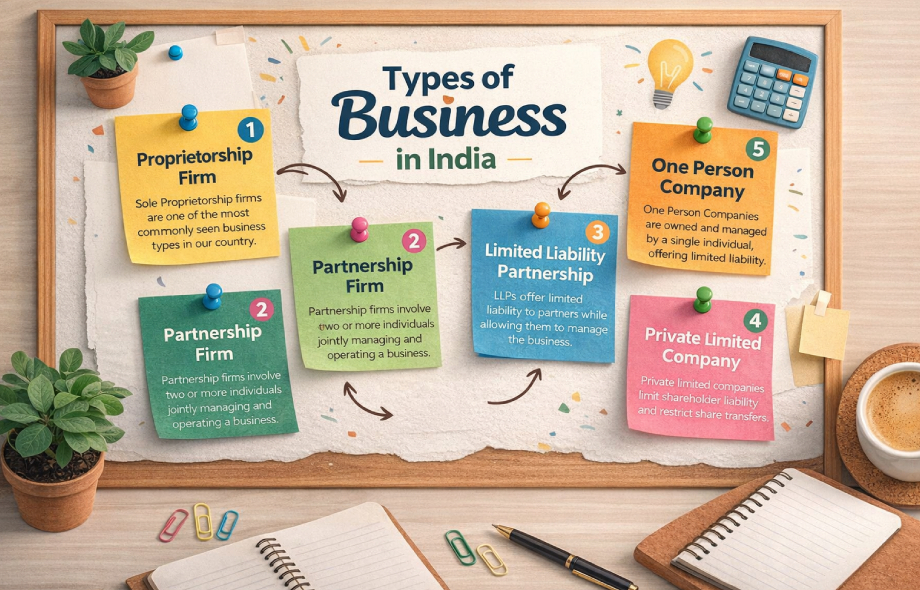
A sole proprietorship is the simplest and most common form of business in India. It is owned and operated by a single individual who is responsible for all decisions, profits, and liabilities.
This structure is popular among small traders, freelancers, consultants, and local service providers because it requires minimal paperwork and has low compliance requirements.
Key Features
Best For
- Freelancers
- Small shops and traders
- Individual consultants
2. Partnership Firm
A partnership firm is formed when two or more individuals come together to run a business and share profits.
Partnerships are governed by the Indian Partnership Act, 1932 and are relatively easy to start. A partnership agreement defines each partner’s responsibilities, profit sharing, and decision-making authority.
Key Features
Best For
- Family businesses
- Small trading firms
- Professional service firms
3. Limited Liability Partnership (LLP)
A Limited Liability Partnership (LLP) combines the flexibility of a partnership with the benefits of limited liability.
In an LLP, partners are not personally responsible for the debts of the business, making it a safer option for entrepreneurs compared to traditional partnerships.
Key Features
Best For
- Professional firms
- Consulting businesses
- Startups with multiple founders
4. Private Limited Company
A Private Limited Company (Pvt Ltd) is one of the most popular business structures in India, especially for startups.
It provides limited liability, credibility, and ease of fundraising, making it attractive for entrepreneurs who plan to scale their businesses.
Key Features
Funds may be used for:
- Startups
- Technology companies
- Businesses seeking investment
5. Public Limited Company
A Public Limited Company allows businesses to raise capital from the public by issuing shares through stock exchanges.
These companies must follow strict compliance requirements and regulatory standards under the Companies Act, 2013
Key Features
Best For
- Large corporations
- Businesses planning IPOs
- Companies requiring large capital
6. One Person Company (OPC)
The One Person Company (OPC) structure was introduced to encourage individual entrepreneurs to start businesses with limited liability protection.
It allows a single owner to operate a company while enjoying benefits similar to a private limited company.
Key Features
Best For
- Solo entrepreneurs
- Independent consultants
- Small startups
7. Section 8 Company
A Section 8 Company is a non-profit organization established to promote charitable causes such as education, art, social welfare, and environmental protection.
Unlike regular companies, profits cannot be distributed to members and must be used for the organization’s objectives.
Key Features
Best For
- NGOs
- Charitable organizations
- Social enterprises
8. Producer Company
A Producer Company is designed for farmers, agriculturists, and producers who want to collaborate for better market access and profitability.
These companies allow producers to collectively manage production, marketing, and distribution.
Key Features
- Farmer cooperatives
- Agricultural businesses
- Rural producer groups
9. Cooperative Society
A Cooperative Society is formed by individuals who voluntarily come together to meet common economic or social needs.
These organizations operate on the principle of mutual assistance and democratic decision-making.
Key Features
Best For
- Housing societies
- Agricultural groups
- Credit societies.
10. Branch Office / Subsidiary of Foreign Company
Foreign companies looking to expand into India often establish branch offices, liaison offices, or wholly owned subsidiaries.
These structures allow international businesses to operate in India while complying with foreign investment regulations and RBI guidelines.
Key Features
Best For
- Global corporations
- International startups
- Multinational companies
How to Choose the Right Business Structure
Selecting the right business structure depends on several factors.
For example, small businesses often begin with sole proprietorships, while startups seeking investment typically choose private limited companies.
Final Thoughts
India offers a diverse range of business structures to support entrepreneurs at every stage—from solo founders to multinational corporations. Understanding these options is essential before registering your company.